BC152 - Five Mixes: Old Sets from New Lists, 1995-2021
Looking and listening back with Resident Advisor and Disco Pogo

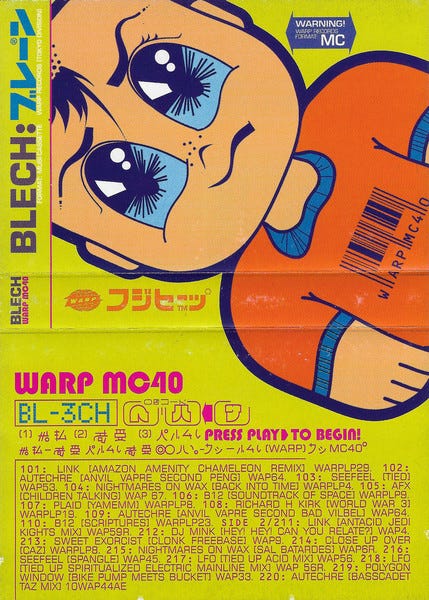
The mixes under consideration this time out came my way the same way they came to everybody’s attention recently—through a couple of retrospective lists of classic DJ sets. The big one is Resident Advisor’s Top 50 mixes of the past quarter-century, to which I contributed, as noted (cf. BC151). Four of the sets here come from that list, chosen in part because in the piece, the links all came from YouTube. That’s also where I found my fifth and also first set, which is on another list: Disco Pogo’s “30 Mixes of Madness,” which accompanies a feature by Ben Cardew on the history of the mix CD (scroll down for the list). Before I get into the mixes, though, I want to talk about how these lists talk to one another, and don’t.
There’s not much overlap, since they cover almost entirely different eras—Disco Pogo is heavy on the nineties. The only two titles in common, not surprisingly, are from 2001 (Craig Richards’ Fabric 01) and 2002 (2manydjs’ As Heard on Radio Soulwax, Pt. 2), smack in the high CD era. But it also reflects two very different publications: consciously cutting-edge RA versus happily middle-aged Disco Pogo. Not to mention a carefully weighted and calibrated poll involving dozens of participants, on the one hand, while on the other you have a sidebar for a feature that was probably chosen entirely by the author, maybe with some input from an editor or two. That’s quite a difference in scope. Nonetheless, there’s a point to the comparison—it illustrates larger taste formations worth noting.
Disco Pogo celebrates the CD mix as a format; RA chronicles its replacement by online sets, in the world and in the canon alike—indeed, the rise of digital DJing is what I wrote about for them. In four cases, RA chose different sets by some of the same DJs Disco Pogo listed. Two of them found RA replacing a CD with an online set: Optimo (Disco Pogo went with How to Kill the DJ, RA with Optimogeddon) and Sherelle (Fabric Presents versus the fifth item below). The other two—Richie Hawtin and Jeff Mills, of course—simply traded in nineties mix CDs (Decks, EFX & 909 and Liquid Room, respectively, for Disco Pogo) for 2000s ones (DE9: Transitions and Exhibitionist for RA).
Excuse me—early 2000s ones. Hawtin and Mills are among the few DJs from that period whose audience skews young in any real way or shape; but beyond the unimpeachable old stuff, nobody is looking to them for their new sets, per se. Convinced that Hawtin’s Boiler Room Paris set from May is his best in decades, I hope that won’t always be true. On the other hand, I also remember tromping around a field while Mills played the usual in Belgium eleven years ago and learning what “business techno” meant.
And yet, I don’t think it’s just me being an old man that makes it striking to see some of the other names Cardew chose that RA didn’t. Coldcut, Strictly Kev & PC, LTJ Bukem, the Chemical Brothers, Kruder & Dorfmeister, Nicolette, Gilles Peterson & Norman Jay, David Holmes, Dave Clarke—does anybody under forty care about them? Well, sure—young D&B adherents are certainly aware of Bukem, for example—but my point stands: For an audience inundated with an entire globe’s worth of dance-music styles, and dozens of potential mixes to choose from therein, names on old CDs must seem merely like time pieces, certainly not like new possibilities.
Granted, one thing RA did not do was to include any of its own podcasts (or otherwise RA-branded sets, e.g. RA Live) in the quarter-century list. This was probably wise—we can only begin to imagine the uproar if they’d thrown one in. (Not least from the other DJs who’d contributed to the RA Podcast and not been chosen.) And, of course, the RA.1000 project acted as another historical-cum-present-day overview—and that included DJ Harvey b2b Andrew Weatherall, both of whom are repped by Cardew (with Sarcastic Study Masters and Masterpiece, respectively), but are not on RA’s century mixes.
Some of this is deliberate—in the intro, RA’s editors note that they calibrated the lists to mitigate against bunching up on particular areas (my phrasing, not theirs), so it’s likely some mixes were left off due to placement on one of the other lists. Michael Mayer’s Immer, which was number one on RA’s 2000s decade mixes list, isn’t on this one; there are two Kompakt titles on the Releases list. Like that.
Even so: Daniele Baldelli and Larry Levan, both on Disco Pogo’s list, may be too old to have been included in RA’s rigorously forward-looking selection. But not only is Cardew right to include the latter’s Strut CD, which was recorded in 1979, but so would RA have been: It was not only released in 2000 but also had an effect on contemporary dance music—in 2000, not in 1979. Also, nothing on the RA list by Erol Alkan, someone as integral to DJ culture as anybody over the past quarter-century?
Let me hasten to add: I’m here to analyze, not bury—RA’s list is robust and teeming, only just beginning to yield great music I hadn’t (and you haven’t) heard before. When it was published, I only knew twenty-two of their fifty mixes. I’d guessed less of an overlap, frankly. It’s heartening that it’s larger, given just how many mixes are out there. In fact, I had hoped that, as they did with the bulk of their Tracks and Releases lists, RA would add secondary recommendations for some of the mixes. Those broadened the overall selection smartly—a total of some nine hundred titles. I don’t read this as a face/ass-saving measure, either; it’s the right method for an ocean this big.
Speaking of size, I must note two of RA’s picks in particular, since they both bookend the list (more or less) and also provide a tongue-in-cheek commentary on it. At number two is dBridge & Instra:mental’s Autonomic Podcast Layers 1-12 (MixesDB), credited as 2009 but actually going into 2010 as well. A dozen sets in one place is cute enough, but then at the very end, we get a complete cheat. RA finishes its list with a friggin’ archive containing, let’s see, 965 mixes (or so: I may be misreading a numeral). Between them, they constitute a clever gag about the impossibility of getting one’s ears around “it all.” But it’s fun to try.
You can hear the five sets below at this YouTube playlist.
Strictly Kev and PC, Blech (Warp cassette, rel. December 11, 1995)
Proportionately, Disco Pogo’s selection has about as much that’s new to me as the RA mixes list. As the list header indicates, Cardew starts with Coldcut’s 70 Minutes of Madness—a CD I have never loved despite endless second tries: pretty good, not amazing, at least to my ear. That’s not a dismissal—more an admission—but it also set up a second selection that was both intimately related and previously unknown to me. Tape-only and billed as a compilation, not a mix, like so many other titles from this period, Blech was a traipse through the Warp Records catalog, which was still as much dance music as undance music, if you will.
The early Warp catalog is full of glistening gems, of course, but they don’t ride on a singular rhythm for more than a couple tracks at a time. Kev and PC, a.k.a. DJ Food, had already made their names with a series of breakbeat beat tracks on the fledgling Ninja Tune label. (See also my “The Primer: DJ Tools,” from The Wire 438, August 2000.) Strictly Kev and PC were the right people to tackle this particular project, because they came out of DJ culture as a kind of go-wherever cut-and-paste, rather more than from the train-track school that rose up with acid house.
This cassette-only release came out only two months after 70 Minutes of Madness (rel. October 16, 1995), but it doesn’t ride that release’s coattails so much as move in another direction entirely. Nevertheless, it does seem like a follow-up, in a very real sense—a next step, connecting thornier work in a way that plays elegantly. It all fits together musically even if the beats don’t play the same—in the first half of the nineties, Warp had a readymade identity, combining innovation with whimsy, always a winning combo among British geeks. For all the self-anthologizing Warp has done over the years, Blech is the most inviting possible introduction to their early catalog, because it feels of the moment, not retrospective.
Blech harbored a sequel in 1996, and the original mix was issued in a shorter version a year later as a cover-add-on to the UK Wax Magazine. Ironically, according to Rob Young’s Warp: Labels Unlimited (Black Dog Publishing, 2005), “By the late nineties, it was no longer possible to talk about a ‘Warp sound’—it was more about a Warp state of mind.” He goes on: “A distinguishable new phase begins around 1996, after the setting up of Blech, the club night in Sheffield and attendant CD compilation, where the Designers Republic replaced their earlier stark and dense style with a more human, user-friendly, and fun logotype and cartoony vibe influenced by Japanese packaging and graphic design.”
Ricardo Villalobos & [a:rpia:r], CircoLoco @ DanceTrippin.TV (October 6, 2009)
Here’s the canonizer’s dirty little secret—we love collaborations, because it gives us two artists in one slot, leaving space for others. Not that (say it along with me) [a:rpia:r] had a snowball’s chance in hell of making this list on their own.
It’s not the Ricardo Villalobos mix of record on earlier RA lists: in January 2010, the site’s Top 50 Mixes of the 2000s put Fabric 36 at number eight. (RA’s 2010s list of twenty mixes featured no Villalobos sets, though it did mention him in its blurb for Nicolas Lutz’s Louche Podcast 108 [June 13, 2013], which is also not on the quarter-century list.) And, because why not, my own Villalobos pick in the TUIM Mixography (for Chapter Sixteen) was HR Clubnight (September 6, 2003), which I chose in part because it’s three hours long: extended length was as much part of the Villalobosian ethos as anything, especially then.
Honestly, all these various choices seem correct to me, even if I don’t consider Fabric 36 a mix, per se—it’s all one artist, by the artist, which goes against my idea of a mix as a making of something whole from previously unconnected parts. (I feel the exact same way about Alive 2007 and 100% Galcher, RA’s third- and fourth-place “mixes.” One’s a live set, one’s an album—the latter an opinion ratified after Ghostly International officially put it out.) But with a few exceptions (cf. Liquid Room), “the mix of record” tends to be a constantly changing thing for most DJs, and that’s as it should be. It really does depend on who’s hearing it and how and when.
In the case of this CircoLoco set, what we see is also important—an outdoor crowd, very queer, very mellow-celebratory, sometimes riding one another’s shoulders, lots of face paint—as elliptical samples waft off like the breeze, echoing dimly but not disappearing, one patient pattern at a time. As much as the other Villalobos choice from the overall RA quarter-century listing (“Que Belle Epoque,” 2006, was the number three Track), the gradual, successive overturning of elements in pursuit of the (w)hole is as definitive as he gets. That said, my favorite ever Villalobos moment is the one I was there for, at Time Warp Brooklyn in late 2015—when, atypically and devilishly, he dropped the Outhere Brothers’ “Fuk U in the Ass.”
Side A
Side B
Ben UFO, Untitled (The Trilogy Tapes, rel. December 2010)
“A ‘20 Ben UFO mixes of the decade’ list would not have been difficult to conjure,” I noted in Mixmag a half-decade back, and if I had, this would have likely been part of it: I’d have visited it sooner, at least. Having never been (and never gonna be) a cassette revivalist, it’s likely that I dismissed it in favor of the abundant number of readymade online sets—not least because January 2011 was when my MacBook crashed and I had to borrow my mother’s PC, a veritable bedbug hotel, which halted my listening significantly for months. Heard now, it works as both a summary of what Ben UFO was doing in 2010 and a typical example of it, which around here is an automatic recommendation.
Kaytranada, Boiler Room Montreal (December 18, 2013)
The way most Boiler Room sets reached me early on was not through YouTube but as a podcast, uploading dozens of new sets every week for my immediate acquisition. Therefore, I find the aesthetics of a BR video mostly irrelevant—I face the speakers, not the DJ—and that was central to my re-acquainting myself with this one. I’d heard/seen it before, but it didn’t blow me away musically then and sounds fine-I-guess today. No, the action is on the screen, and Bella Aqualina’s blurb captures it:
In a seemingly bare room, they form an unlikely ensemble: “tall girl,” part Topshop campaign, part burlesque wink; “sweaty check shirt guy,” committed to a struggle with his own sweat glands; and, of course, “Boiler Room girl,” popping and locking with unshakeable main character energy. They flank a grimacing Kaytranada as he navigates the chaos like a captain steering the ship home.
Sherelle & Tim Reaper, London Unlocked (London Coliseum, April 27, 2021)
One of the great things about listening to highly rated but heretofore unknown sets the first time is when they induce an “Of course!” In this case, it happened almost instantly—of course this was someone’s canonical set, not only because of the personnel involved (the two-for-one rule again) but because it friggin’ knocks so hard—an inarguable UK low-end masterclass. And the video is also a draw. It’s shot professionally and with a sense of drama that connects to the music; it also enacts deep lockdown, both DJs masked and keeping their distance, the coliseum completely and eerily empty of an audience, particularly so when the crowd noises and air-raid sirens sound their way up.