BC182 - Interview: Barry Walters (June 2026)
Opening up with the author of ‘Mighty Real: A History of LGBTQ Music, 1969-2000’

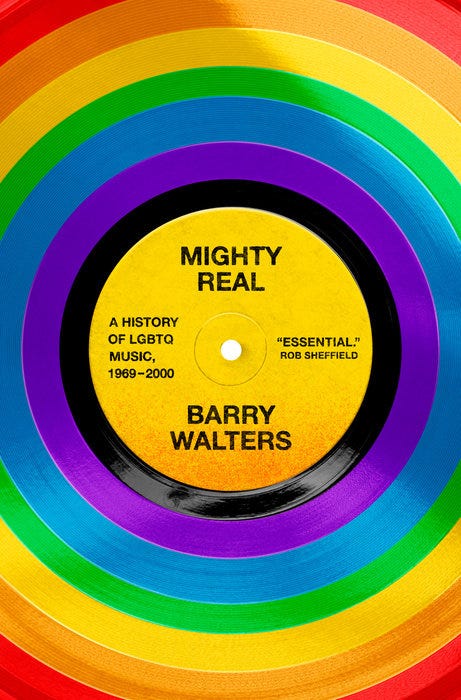
Barry Walters’ Mighty Real: A History of LGBTQ Music, 1969-2000, which Viking published in May, offers more than a history. It offers a queer musical cosmology. In it, Walters reads sixty artists, labels, and eras strictly through a gay lens, and that strictness is an argument about fandom as much as history.
Speaking of history, Walters also shows just how queer pop has always been, behind the scenes as well as up front. Add up all of Mighty Real’s gay and lesbian and bisexual managers and executives alone, and you have a readymade biz pantheon to go alongside that of the performers.
I don’t think there’s a sentence in this book that tells me something I already knew, and I don’t just mean about gay life—I mean about music, period. Ziggy Stardust is “the defining Bowie album because it’s the most fictional.” Writing on Bush Tetras’ “Too Many Creeps”: “Several early eighties mixed-gender groups . . . evolved out of punk yet took cues from the build-ups and drop-outs of disco,” Walters notes. Permit me an emoji: 🤯
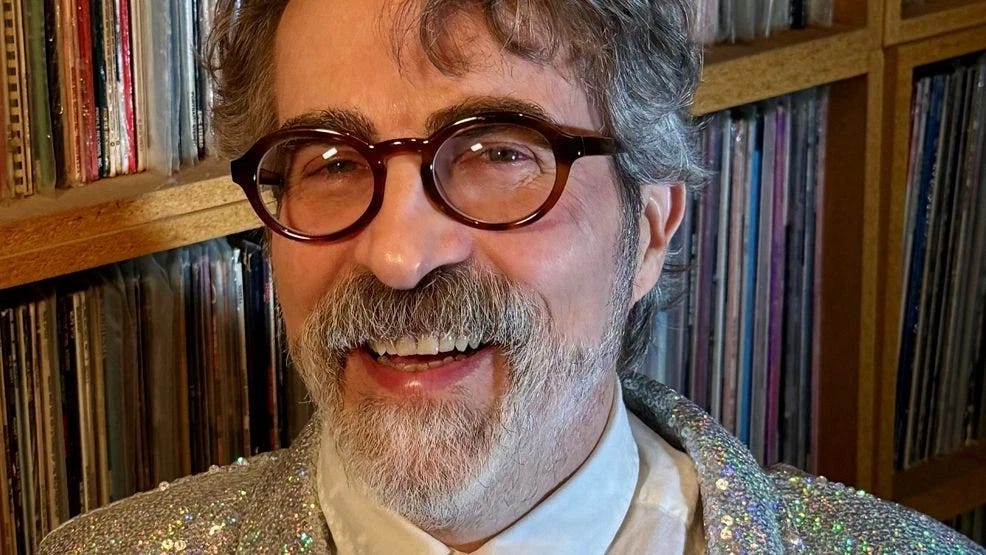
Barry Walters via WHAM
Walters takes gay liberation as birthright and lodestone. And he never stops being a critic, thank goodness. On the Miracles’ “Ain’t Nobody Straight in L.A.”: “Chocka-block with cha-cha rhythms, Spanish guitars, bilingual lyrics, and flutes, it’s unmissably Latino and gay—like a penis-shaped piñata filled with rainbow glitter exploding over the group.” A+. One page later, Jim Stafford’s “My Girl Bill”‘s “god-awful ending.” While Vito Russo’s The Celluloid Closet is one of Walters’ stated models for the book, I also think David Thomson’s Biographical Dictionary of Film is an apt comparison, for its emphasis on telling moments over dry completism.
Walters has no doubt been told—and should be for the rest of his life—that this book made its LGBTQ readers feel seen. But one part made me feel seen: His typification of Talking Heads’ “The Girls Want to Be with the Girls,” in which David Byrne is “not angry; just puzzled.” That is exactly how it registered to me as a teenager: A song by a conscious ally who does not quite yet get the codes. I had never known how to put it into words, and he nailed it. I told him this, and also asked him some questions on Tuesday afternoon. Barry took a nap afterward.
A book requires in some way to put everything you have and everything you can into it. That seems like a good way to describe Mighty Real. It seems like you started with a large task that kept growing larger. Was it?
Well, certainly, for the first few years it grew—as you know, because you helped solve one of one of my problems: I was going to begin with the beginning of recorded music and encompass people like Bessie Smith and Ma Rainey. I realized that was insane, that if I were to do that, I would just be limited to Wikipedia-type entries on everything, and I wanted to go deeper than that. So your suggestion to start at the Stonewall riots in 1969 was a great suggestion.
Thank you!
Then I had to figure out when I was going to end it, because the longer I worked on it, the further the present, in a sense. It was originally intended to go to the present day. So I ended it at millennium, because that is when a lot of people went online, and therefore young people didn’t have to put on a record to learn about themselves. They could do that by just going online and meeting another gay person, or LGBTQ person.
There was a lot of trial and error. I ended up writing way more than I used in the book, and that was my intention. This is my first book, so I had to teach myself how to pace myself for a large book: how much detail I would use. That kept on going through the editorial practice—really, until the last minute, I was adding and trimming things.
When I’m reading this book, I’m like, “Yeah, this must have taken eight years, because there’s so much in it.” The personal stuff really hits hard, pretty much from beginning to end. I don’t think there’s an infelicitous sentence in the book.
Thank you.
The pleasure of it is that I’m putting myself in the hands of somebody who really knows what they’re doing as a writer—and also because I trust the guy I’m reading, because the critic in him never sleeps.
Thank you very much. I wanted the reader to be able to trust me. Obviously, we’re in a time when everyone is a critic and everyone has an opinion on things, and I wanted to share—without bragging—that my opinions or my interpretations are a little more trustworthy than the average listener, given my proximity to the material. I’ve been immersed in it my whole life. It’s what I love. Unless I’m seeing a movie or playing with my dog, it’s often the sole focus of my life.
Did it surprise you that you wound up writing a lot about your own life in the book?
No. At first there was next to nothing of my life in the book. I have to admit: My therapist at the time encouraged me to put myself in the book. I guess he felt like my stories were very compelling, about my connections to these people and this music. It was my intention not to do it in an egotistical way. Yes, I did want the reader to trust me, and therefore I needed to let them know that I went back with this music until I was a kid, and that I’ve been covering it since 1984. But beyond that, I felt like if I talked about my relationship to the music, it would help the reader think about theirs. That was really the strongest motivation.
Toward the end, I went online to see what had been written about to Depeche Mode’s relationship to LGBTQ culture. I did a search and read this article, and within a couple of paragraphs, I realized that there was reading something clearly generated by AI. It was the first time that that that I ever seen an article like that. Now that’s starting to become commonplace. But a couple years ago that was a novelty. I realized that AI is going to be—is—attempting to replace us.
I felt like, “Well, what can I do that a computer program can’t do? I can give a perspective, I can give life experience, I can give insights into feelings and vulnerabilities and histories that AI just can’t do.” I guess even before that, I felt like I aimed to minimize what was in the book that was already out there and maximize some kind of unique, or just specific, perspective that hadn’t been put out there before.
Like, when I wrote the little bit about being a six- or seven-year-old, and looking at the cover to Sgt. Pepper, and seeing John Lennon have his hands stuffed in the waistband of his pants. I thought, “OK, that is probably something that no one has written about Sgt. Pepper.” That’s a hard thing to do. I guess that is a microcosm of the whole book. Many of these acts have been written about since the nth degree, and so I tried to come up with stuff that I had never seen before, which, of course, is a challenge.
It’s why you overwrite and then cut.
Yeah, exactly.
You did that especially well with—and speaking of speaking of artists that you looked up stuff for: When I was writing Can’t Slow Down, I wanted to certainly address Michael Stipe’s queerness, and I wanted to do it in a respectful way, and I think I did. But I didn’t go in on it the way that I would have been able to if I’d had a different toolkit. Your essay did exactly what I have been waiting my entire life for somebody to do with R.E.M., to read them in that way. I didn’t know he was queer for many years [when Stipe came out in a Details article by Chris Heath in 1994], and you get the clues when you look back, but you didn’t need the clues like I did.
Right. Well, I had that moment when I was interviewing him in Athens for Life’s Rich Pageant, and I just saw his head follow this shirtless guy, and he commented, “Oh yeah, that guy always walks around shirtless in the middle of town.” I thought, “No way a straight guy would say that. He just wouldn’t. He wouldn’t care.” So in that instant, I thought: “He may still be into women, but he’s not entirely straight.” That was something that stuck with me.
It’s a real challenge. I mean, R.E.M. had some of the most famously obtuse fans. And I’m not saying it’s because he was gay and in the closet or unsure about his sexuality or any of those things. But I do think that, given that, it is so different, it was so difficult, particularly back then, for anyone, little let alone the singer of a band, to come out that. I do think it really shaped part of the soul of R.E.M. to have someone who could not be completely upfront about who he was writing the lyrics.
That applies in a lot of ways to the broader eighties milieu of indie, which you write about as well. How do you think that era might have been different if people were less closeted?
That is a big question, and there are different sides to it. I think that the fact that they were closeted allowed bands—clearly, R.E.M. had much more to do than just the sexuality of the lead singer. That is really true of most bands, but because it still remains such a defining feature of someone that they’re not straight, once you say that, that becomes your headline, in a sense. I think that’s what Bowie had commented on himself—he came out in England, and that certainly helped him over there, but over here, where we have an even stronger double standard about morality of sexuality and religion. Many people didn’t get beyond that aspect of his identity. Now, it is certainly less of an issue, but still, I think that once someone comes out, that does become their headline, in a sense. But some people, I think women, are more able to get past that. Certainly, Chapelle Roan has. But for the leader of a band whose fans are predominantly male—certainly in R.E.M.’s case, not exclusively—but still, they are considered a classic dad-rock band, right?
At this point, anything past the seventies, they would be it, right?
You could say the same of Wilco, but still, Wilco are never became really more than a very large cult band. Their songs weren’t played on Top 40 radio and their videos weren’t played on MTV at a time when MTV still shaped what was popular in much of the world.
You identify everybody who’s queer in the book as that. Immediately, I thought, “I couldn’t get away with this.” It’s not a complaint in anyway; there’s a reason for it, which is as you said: If I were to do that, I’d be making that the headline.
Well, it is the headline in this book, absolutely. But actually, it’s not “Who is gay?” It’s “What is the gayness of the music that gay people are listening to?” Some interviewers are fascinated with the idea that something can be gay music and not be made by a gay artist.
Cher might be a perfect example. We all know that Cher is adored by a lot of people, but certainly LGBTQ people have stood by her and championed her at a time when her records weren’t selling or she wasn’t getting radio play. I think her heterosexuality bona fides couldn’t be clearer. There are other musicians in this book who are a little more ambiguous. I don’t think we will know some of the sexuality of some of these musicians until they pass. Because it still does remain libelous to say that “so and so is gay,” particularly if they’ve not said so themselves directly. Even though many of these acts have said so indirectly throughout their careers.
Obviously, you re-used some of your old journalism and criticism here. But you also go beyond it: The framework demanded more of a holistic overview than working to deadline often allows. Going through your own older work, did anything surprise you that way—getting it right when you hadn’t realized it?
I don’t know if it’s for me to comment on that. But a couple years [ago], producers from the BBC flew me out to L.A. to talk. It was for the documentary Disco: Soundtrack to a Revolution, because they had read the Sylvester feature I wrote for the Village Voice back in 1988. I was only 27 at that point, and yet looking back, I really did pretty much nail the relationship many gay men have with divas. That’s something that we all know about, but it’s not often commented on, I guess.
Race is also still a delicate subject, and it’s difficult to explain. I do think that we’re in, and for good reason, a true moment that is looking at appropriation and looking at ways in which white audiences co-opt black musicians. But I’m sure someone like Patti LaBelle will tell you the relationship of between her and her gay fans is a beautiful thing that has sustained her and kept her career going.
The same is the same is even more true for singers who dropped off the charts long ago. Someone like Thelma Houston can still get gigs playing at gay pride events. She’s not going to get those gigs very in other places, or not be playing the same size audiences. When singers like her appear before us, we really show her appreciation in a big way. Those women, I know that they appreciate it.
Patti LaBelle, that was a perfect example. I interviewed her a few years before I wrote about Sylvester, and when I told her, “I want you and some other singers to comment on the relationship of”—to try to explain Sylvester’s legitimacy as a singer—she’s like, “Oh, honey, I’ll hook you up.” And within a moment she gave me Gladys Knight’s home phone number.
One thing that you do in this book is explain what a track show is, for example. That’s something that you don’t see in most music writing, period, even dance-music writing.
Oh sure, right. That has been a staple of club shows ever since I can remember. I think rock fans who are accustomed to seeing bands every time someone performs, they’re shocked when with when it’s just a singer and a tape. I forgot what at what point . . . ?
Grace Jones.
That’s right. Yes!
Grace Jones was the queen of the track show.
For her, what I found fascinating was that she actually took requests. We have this image of Grace Jones as being this inflexible statue, right? Very severe, really a dominatrix with a microphone.
[Laughs] Wow.
Here she was, she singing really deep cuts and telling her sound man: “Yeah, I’ll do the song from my second album that I probably haven’t performed in decades. Why not?”
Because those are the real fans.
Yeah, and I think she understood that. It wasn’t like she was doing some corporate gig. I think she also knew that it was a time when you didn’t know if your friends were going to be alive the next time you came to town, so I think she was being very generous. It was just striking to see that aspect of Grace Jones. I finally met her subsequently, and she is like that, she does have that other side. If she respects you, she really shows you that she loves you. So that was a wonderful byproduct of writing this book.
There is so much nested information in here—not least the way that a good deal of what preceded Stonewall makes its way in through figures like Bette Midler and your overview of early disco. My favorite of these is the way you utilized, in the Motown chapter, “The Tears of a Clown” as entry point for a consideration of Paul Lynde and Charles Nelson Reilly. Was that a case where it came to you during the writing, or was it always there for you?
Actually, that was a real tough one, because . . . Mind you, much of the book went through multiple drafts and revisions. I was constantly adding and subtracting. But I wanted to illustrate a certain element of gay culture. We think of it as being especially on the male side of things—as being flamboyant, that overused word. You know, the Gay Pride parade float where there are drag queens and there are leather daddies and everything’s over the top.
I do think that for the longest time, straight culture was most accepting of us if we did play the clown, and for me the ultimate expression of that was Charles Nelson Riley and Paul Lynde on daytime game-show TV. I really was drawn to those two as a kid, and I found them really funny, really compelling. I didn’t realize that I think I was drawn to them, definitely. I was definitely drawn to people like that, before I knew anything about myself being gay, I just really admired their ability to think they would come up with dialogue that seems scripted, seemingly off the top of their heads.
I knew I wanted to write about Motown, and I knew that there was a lot in there that’s gone unsaid about why LGBTQ people love it. Once I thought about that song in particular, I guess that was an Aha! moment for me: I can give the reader a lot of context through this song. I wanted the book itself to have that quality to it.
At Viking, my editor and her assistant, were being very helpful in trying to come up with examples of book jackets for books that were like mine, and they were dark, they were very historical-looking, they were very specific to a very specific topic, and I thought, “Oh no. I want to go in the absolute opposite direction.” I wanted the book to have that Gay Pride parade brightness to it. I wanted it to look like as though it could have been designed by the same album design firm that worked for the Human League and Duran Duran and Buzzcocks. I sent them links to that—Assorted Images. And I came up with the image of the record, the rainbow record. I don’t know if you noticed, but the label, it definitely is Sire Records.
It’s very clearly Sire Records. So what was it like getting blurbs?
I decided I would call on folks who that that I’ve kept in either kept in touch with or I have friendships with, or whose art or music I admire. I sent in a lot of requests. I got close to certain artists, but it didn’t quite happen. But I was just overjoyed with what did come in.
Some were long shot, like Tig Notaro. I saw her documentary about having cancer and turning that material into her comedy. I think she wears an Adam Ant T-shirt in that, and that struck me. You don’t think of lesbians as being Adam Ant fans. But there is a quality about him that—this is no secret: Certain boyish lesbians look like cute boys.
Oh, totally.
I thought, well, “Adam Ant sort of looks like a cute lesbian.” Anyway, I didn’t say any of that to her. But I found out who her manager was. I sent a request, and lo and behold, I got a blurb. So you never know. I did definitely get lucky, yeah. But then again, there were times—I wish I had gotten something from Madonna. Maybe she will, if she gets a hold of this book, give me an endorsement down the road.
You’ve been to the Loft, CBGB, and the Paradise Garage, all of which were alleged to have the best sound system in New York. Which one was the best?
[quickly] Paradise Garage. I have to say that I did not go to the original incarnation of the Loft, so I can’t comment on that one. I went years later.
OK, but you went.
I did go to other incarnations of the Loft. But I will say that, to me, the Garage had the most amazing sound of any place I went to. I mention [in Mighty Real] that the first time being there was at a New Order show the summer of 1983, and the music ricocheting through the club, just whirling around front and back and left and right: I’d never heard anything like that before. Then I went as a regular dancer on a regular night, and the sound was incredible. Nothing to that has still been equal for me.
Thank you for teaching me so much about so many people I love.
Oh, thank you. I’m glad. I wrote this book for what I think of as my people. And also, my children. In some ways, I mean that literally, because I have, through my husband, a stepson who went to college for music engineering—his favorite artist is SOPHIE—and I have a stepdaughter who now identifies as non-binary, and she has a trans partner. I wanted to leave something behind that would shed light on my experience, the experience of my generation, and to help kids now, too.
It’s clear that things are going to get worse before they’re going to get better, in terms of what’s happening politically. So I wrote the book for people like me and the people who are now like I was when I was 13 years old. But it’s very satisfying that people who aren’t in that demographic, who are straight and just love music, or want to see and learn about other aspects of the music that’s already been in front of them for years. I made sure that there would be a few acts in the book that the average listener wouldn’t know. It really makes me feel loved, to be honest. I’m very grateful that people are showing that love to me.