
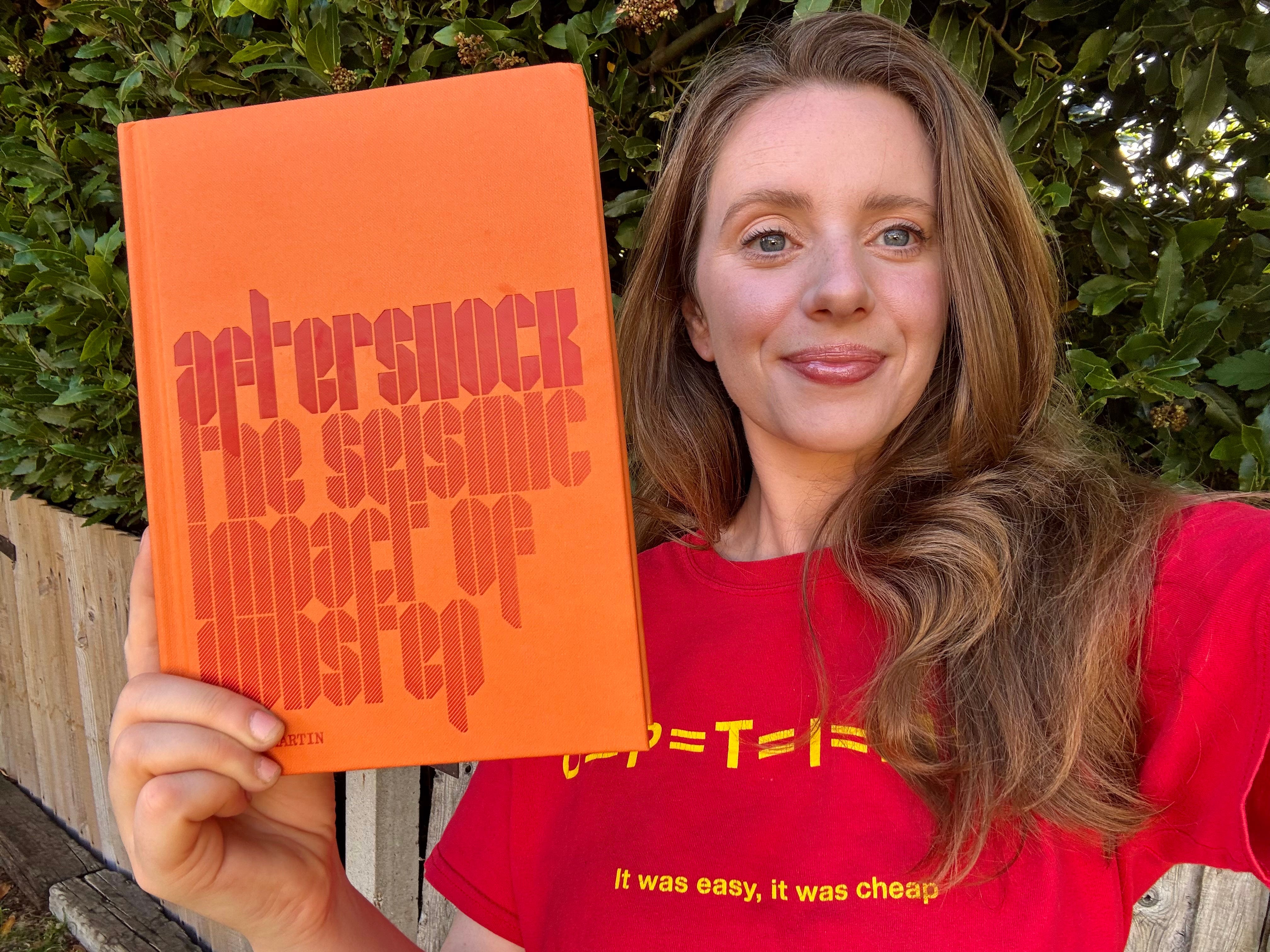
Today we conclude our discussion with Lauren Martin, the London-based author of Aftershock: The Seismic Impact of Dubstep, now available in North America!
The discussion picks up where we left off last time: Martin picked N-Type’s Dubstep Allstars Vol. 5, about which Lauren said in email: “The Caspa and Rusko Fabriclive 37 mix is famous, but I think this also shows the turning point towards a more hyped, dynamic sound and rapid mixing style. I think it’s probably the best in the Allstars series besides 01 and 02, IMHO.”
MM: I’m looking at the page where Rusko talks about FabricLive 37. Its availability in the U.S. makes a big difference, obviously, but it’s not just the availability; it’s also the aggression. It’s the straightforwardness of it.
LAUREN MARTIN: I’m quite a strong believer in gateway records, gateway DJs, gateway artists. If you grew up in Ohio and you heard Caspa & Rusko for the first time, and then you eventually got to DMZ, cool, fine, whatever. If your first experience of dance means it was Daft Punk, Alive 2007, and then you eventually get into Autechre, cool. Everything is a potential gateway. I don’t want to be a snob about that.
But I would say it’s particularly interesting how Youngsta talks about how Americans just don’t have that Caribbean dub sound-system heritage. Why would they possibly listen to Caspa & Rusko and think this is lacking? This is a whole new, immediate experience for them, especially people who have no connection to electronic music culture. Because God knows America has its own problems with acknowledging its own electronic music history, which you know well about.
This is also the gateway into the elephant in the room from America, which of course is Skrillex, because that was most Americans’ idea of dubstep. When I overhear people talk about dubstep, sitting in a cafe or something, they’re not talking about what we’re talking about. If I were to play this stuff for a younger American and say, “This is dubstep,” they wouldn’t know what the hell I was talking about.
No, that’s very true, I suppose.
I don’t mean that in a critical way. It’s just, they wouldn’t.
No, absolutely. I would say that Skrillex—I think it is unfair to belabor him, as an artist, with whether or not Americans like Mala or Coki. I think that’s like really personally unfair to him. I say this in my epilogue: If he knew what dubstep was, and even if he was listening to this stuff, which I wholeheartedly believe he would have, because people started calling it “dubstep-adjacent.” I am sure his first entry point into it was something like Caspa & Rusko, and not DMZ. He couldn’t possibly. He was an emo kid who grew up in the States. If anything, he and his audience bypassed the British dubstep experience, because why would they have a connection to it?
I will push back on that slightly simply because when he won his first Grammy in 2012, he went out of his way to thank, and I quote, “All of the Croydon crew.”
Yes, he did say that in his speech. But I think also, to his credit, if he had made shitty copies of “Anti-War Dub,” you would have been like, “What a goddamn hack!” He made something that spoke to his brain, his imagination of music, and loads of people loved it. Lots of people hated it. But if anything, I feel like the extreme noisiness of that style has actually gone on to become just like broadly just American EDM.
Yes, that’s basically it.
It’s a misnomer that “EDM” in the U.S. is anything to do with house and techno. “EDM” is actually highly aggressive dubstep, for the most part.
Absolutely. It’s like comparing Black Sabbath to Chuck Berry.
Yeah—they’re just different things. It’s just completely different approaches to guitar.
This might sound a little immodest, but I don’t think anybody used the term “post-dubstep” before I did. It was how I accounted for the early Punch Drunk stuff—I was writing a lot for RA at the time, a lot of reviewing of 12-inches, during a very fertile time. And I’m curious, how did the mainline early guys feel about that stuff? I would imagine it was a lot of mixed emotions.
When I immediately think “post-dubstep,” I’m thinking of the Hessle Audio crew. I’m thinking of stuff like James Blake, Mount Kimbie, which is more in the indie-pop strand. If anything, “post-dubstep” was a very busy house. There was a lot of people coming and going, even the Joy Orbisons. I think it was a very broad umbrella term.
I have to say: The vast majority of artists within it probably didn’t enjoy it, because they did not want to feel like they were an afterthought to something that was very influential, or that they were trying to refigure something that actually wasn’t that old, and had only really just taken off. I have to say the book cuts off in 2011 because I wanted to keep it to be quite a tight narrative. Part of the reason why it’s not explored in the book is that I wanted to explore a decade in as much granular detail as possible, rather than trying to do rather than trying to do everything that is adjacent to dubstep.
Then it’s seven hundred pages.
Yeah, exactly. Whenever I did privately bring it up with people, it was mostly pretty magnanimous. Things are going to evolve. If anything, there was a healthy, respectful distance between it, because actually what a lot of the post-dubstep people were genuinely drawing from was a massively renewed interest in house music, and it wasn’t coming from the same junglist sound-system background. It was actually more music for house and techno clubs, and eventually becomes more [in the] indie-pop kind of sphere. I feel like the rooms were different, really.
Oh yeah: By the early 2010s, by the time that EDM starts to pick up in the States, Skream starts playing house sets, for example. He starts playing disco. Not all of those guys, but a few of them certainly, shifted their focus; I don’t feel like it was cynical at all. It was a natural thing for a lot of them.
Yeah, absolutely. This comes across in the book as well, in maybe the last, like, three chapters, in different ways: Just by the sheer fact that vastly more people became interested in dubstep in the late 2000s, moving into 2010, by the sheer force of things like the Dubstep Forum, these people touring internationally much more, getting broader audiences and eventually a broader scope of people who will start to make that make something adjacent to that music. It’s no longer thirty-five people on the Plastic People dance floor who all personally know each other.
Loefah has a really lovely line in the book where he says you know one of the when right after he finished his set on the “Dubstep Warz” broadcast: “One of my favorite things about dubstep and what we did is that at any given point I can look around the room and see all my childhood friends.” That quote’s really stuck with me, because once the sound became famous without them, that obviously would engender a lot of feeling. Especially when they were doing it genuinely not to be famous.
One of the things that I really enjoyed extrapolating on in this book—maybe not overtly in-your-face—but dubstep, along with grime, was the last new innovative genre from the UK that happened at the exact same time as exploding platform capitalism, file sharing, social media.
It is really interesting to listen to artists speak, and not much older artists—not like artists in their sixties or seventies. Artists that are maybe fifteen years older than me—I’m thirty-seven—speaking about making music, people that are late forties, maybe early fifties now. Speaking to people who were genuinely making music with zero concept of brand, of career, of marketing yourself. It really comes across in how they talk about their work. It’s ambition without capitalism.
They actively didn’t even consider [that success] to be something they wanted, and I think that’s probably why it stung. Not because of a record they didn’t like, or a producer they didn’t like. It became a different beast right in front of them.
I’m thinking of the old compilation title, Macro Dub Infection. It feels like dubstep basically did what that title indicates. The 140 BPM thing, the B-lines made their way into other kinds of music. There’s another thing as well, which is the rise of the podcast and of digital DJ. Those two things are intertwined to me because it’s the beginning of it of DJs playing less in terms of style—like Youngsta always playing the same basic thing because he wants that to be his signature—then being able to just line things up by BPM, and it doesn’t matter what they are.
Did you bring up Macro Dub Infection because that’s also named in the book?
[laughs] I haven’t gotten that far in the book yet.
It is discussed in the book because that was compelled by the Bug.
Yes, I know.
You’ll come across it later.
I’m very much a student of the Virgin AMBT series. That series just blew my head open. David Toop is a hero. But the rise of the podcast is very key here. You had to look for the sets on YouTube, for example. You had to be keyed into the nodes where you would find this stuff. Whereas, when you subscribed to the FACT Magazine podcast and it was downloading on your computer by itself, then that changes things.
It massively does, and it reminds me of a quote in the opening pages of the book, where Loefah is talking about tribalism: “I’m not just going to outright tell you about pirate radio, but if you ask me about it, I’ll tell you about it. I’m not going to tell you the frequency, but if you bother to scroll through and find the frequency, cool. Let’s talk.”
There is an access point that you have to [reach]. There has to be genuine intrigue and interest, and you need to have the curiosity to want to know it. Once you’re in, welcome. But we’re not just going to tell you all about it. We’re not going to walk up to you and say, “Hey, do you know about this thing?” Because this tribalism hive mind, it’s effort, it’s commitment. If everyone likes everything, then nothing special, really. He was like, “That tribalism is core.”
Mala, Boiler Room London: DEEP MEDi (November 13, 2015)
Lauren in email: “I jumped ahead timeline wise here, but this dropped the year I did the original oral history for VICE and Mala’s selection and technical prowess really shine through in this. Mala also said he’d play BR on the condition they brought in a dub sound system, turned the lights off, etc. He’s particular and it really works on the video to generate the effect of a real dubstep dance.”
I want to ask about the final set. To your ear, what is a primary difference between a retrospective like the Mala Boiler Room, and a you-are-there snapshot?
Interesting. I would say that if anything, the exclusivity of dubplate culture within dubstep and the very careful audiophilia of the creation of the DMZ sound and its adjacent releases. So that will be stuff on DeepMedi, as well as like the DMZ label, the stuff that Mala has his touch on.
If anything, I would gently push back and say Mala would not consider that retrospective, and I don’t think his fans would, either because he’s so careful about keeping things feeling exclusive. He engenders this attitude as an artist, where you can play songs that are 20 years old, but in the same way that like Jah Shaka will play the same songs for 40 years, but he will play them in a way that feel contemporary and interesting.
So, if anything, I would say like, yes, a lot of the songs in this set, even in 2015, would have been ten-fifteen years old. But Mala is not someone that floods the ecosystem with his music. He doesn’t do recorded sets almost ever. That quote where he was like, “This is a physical sound, and you must be physically located to hear it”? This was a very rare set he did, because he always refuses to do recorded sets.
He wrote about this in, actually, his RA mix this past year—a very rare one, again, which is excellent. Has a totally different feel to this Boiler Room one. He says, “It’s because I feel like I’m doing the experience of the rave to serve the dance a disservice when I do a recorded one.”
Having said that, though, he apparently agreed to do this Boiler Room on the condition that the room was dark and that the Sinai sound system was brought in especially for it. So, he recreated the conditions of a DMZ dance for this stream, which is why, if you listen to this on SoundCloud, cool, you’ll enjoy it anyway.
But there is also a reason I gave you the YouTube of the actual broadcast—you can see the room and you can see how young everyone is. Probably, most of the people in that room were too young to go to DMZ, so they don’t have that firsthand experience. This is a generational shift in 2015m where they are coming to some of these 15-year-old records fresh, because they weren’t old enough to dance to them the first time round.
But I also think that the way that Mala mixes—it is almost hard to describe how hard it is to be that good at mixing dubs in a dark room, with that level of technical precision, in a way that just makes them sound absolutely seamless. [motions with hands] He has this almost like a tide . . . a tsunami effect where you don’t notice the water is moving back until all of a sudden there’s a crest of a wave, and then it swooshes down on you.
He just does it over and over again. You can be listening for a few minutes and go, “Oh shit, are we on the second track or the third track from that?” Like, you’re just so locked in. It’s like this blanket of sound, and you’re not standing there picking out the blends because he mixes in such a way that . . . yeah it moves like a tsunami wave. He’s so fucking technically good, and he makes it look so easy.
The red light, the way that the camera shifts between perspectives—it all really adds to it. Also, what you’re talking about—the word that I keep coming back to in my mind with all of this stuff, with music generally of late, is “repertoire.” This is a repertoire that you can draw from, reinvent, make new all the time. It comes from me loving Bob Dylan, who does that all the time, and loving the Grateful Dead, who did that all the time. And you obviously see a lot of it in DJ culture. There’s a lot of what I have always called “post-standards.” It’s not like the Great American Songbook standards, where you rework the changes and you add different nuances to the vocal as an interpreter. You’re interpreting it, but it’s as a producer or as a DJ, you’re taking things that are familiar and re-shuffling them, making them different.
I’d say on that point, there are a few elements that are important. I’ll try to say them all before I forget.
One is that music automatically becomes more interesting when there is more quality control around it. That original dubstep sound is really the focus of the book. I’m not talking about the myriad copycats from the 2010s onwards, or the super noisy-screechy stuff. The way Benny Ill talks about this in the book, actually, is that going from physical infrastructure to digital infrastructure meant that the A&R process was stripped out.
I think the reason that you can call it a repertoire, and that the music is so recognizable, is that through the very strict A&R processes—even from Hatcha telling Scream what to make/what not to make, Youngsta telling Loefah what to make/what not to make—those layers of quality control meant that the music that was formally released on vinyl that is known to the public is literally the fucking gold standard. It’s all killer, no filler, basically.
I think that’s why that dubstep repertoire is so recognizable and close. Like if you play Coki, “Burnin’,” and then “Anti-War Dub” and Loefah, “Horror Show,” there’s no confusion about who made those tracks or what those tracks are. So the exclusivity of the output and the quality control the output allows for repertoire to be an easily used one.
They were stripping other genres—that they did genuinely like for a time—for parts, because they didn’t like the busyness, the noisiness, the over-compression, the lack of dynamism, things that were overly engineered and without enough emotion to be memorable. They decided it is a more powerful task to edit music than it is to just keep throwing new shit at it and call it something new—the act of editing out the stuff that they no longer liked, and going, “Well, what is left? What are the fundamentals that we do like?”
If anything, I think that is an incredibly confident way to make music. They’re not doing it because they don’t like their influences. They love their influences. But what they’re saying is, “We don’t like where they’re going, and therefore we are going to do a left-hand turn and create something very different from the ashes.” The really bullish confidence to do that is why the repertoire is so strong. Anybody can make a noise. It’s harder to make the silence around a beat sound good.
That process you’re describing: that’s punk, that’s rap, that’s house. And those are very differently done, in all these cases. But it’s also like, “How can we do this on the cheap?” Whereas I feel like with dubstep, it’s completely purposeful.
There are no accidents. Towards the end of finishing the book, the edit process is that I’ve been interviewing artists for over twelve years now. Comfortably full time for at least a decade. It is astonishing to me how many artists, with the greatest of respect for their output, really do not think about their work in in real time. They are making stuff that feels intuitive, that feels good to them, but they don’t really consider their music necessarily within the broader cultural ecosystem. That’s the job of a writer or observers or listeners to put into a context for them.
Oftentimes, it’s only when you get like the really fucking killers: the Underground Resistances of the world, or the Drexciyas. You get these core crews who actually do have a mission statement, and they’re quite rare. Most artists are making something that feels intuitive, and only later down the line, when they’re being interviewed about it, do they go, “Huh, I never thought of it like that. Oh, that’s interesting you say that.”
But the dubstep people almost absolutely, universally, all were, in the moment, thinking about the creation of their music as a mission statement. “I like X, I don’t like Y. Where is my music going to sit?”
Loefah didn’t like how fast and busy and stupid jungle was getting. He wanted to shatter jungle and make it slower. “How do I do that?” There was a true creative life-force, that was like the funnel towards a task. Like, “I have a mission statement to make a new style.” There’s something almost arrogant about the drive to do that, but none of them come across as personally arrogant whatsoever.
It’s so fascinating that this collection of thirty to fifty people were all very much on the same wavelength, but with quite different angles into the sound. They had a mission. They understood the mission’s goal.
Having written a number of oral histories myself, oftentimes the people involved read it and learn things they didn’t know. My sense with this book, and with the participants in that scene, is that they did know a lot of this, because they were discussing it amongst themselves the whole time. I feel like what you’re talking about comes as much out of conversation as action.
Big time. This is also indicative of the time and the space. I was thinking about, if they’re coming from the outer edges of East London and Essex—because I feel like maybe when they talk about Croydon-comma-London: Croydon is technically just outside London. It’s got a non-London postcode. Croydon’s technically barely London at all.
I’m really fascinated by—I think that living somewhere that doesn’t really speak to you and what you’re interested in affords you the time to be bored, to think, to sit in the house for a year straight making beats and getting better and better and better. The way that Mala, Loefah, Coki, and Pokes all describe sitting around each other’s houses for years making beats and practicing emceeing: I feel like that physical activity, being around each other all the time, talking all the time, making music all the time—[there] was naturally a rolling rhythm to that. It was their lives.
They worked day jobs. They did working-class day jobs. It almost feels like it feels like an artifact of a recent past, because now: Elijah often shares a phrase like, “The rent is the creative director now.” You don’t have the time to make the art you want because you are crushed by cost of living, capitalism, like the busy-ness of life, the demand. It feels like when I was putting this oral history together and just seeing how much time that they were afforded to do this.
Mala at the time reflected on it. He said, “You know, my dad’s [been] a painter-decorator his whole life. I never worked a working-class physical job like he did, and I always felt guilty about that because I had all this time to sit around and make music and read books and smoke weed and think about myself as an artist.” His dad has passed now. But [Mala’s father] turned around one day and said, “You know, if I could ever come back in another life, I’d want to come back as my son.” [Mala] was very moved by that.
That constant talking-about-it is actually a result of being physically located with other creative people and being afforded the time and the money and the space to actually fucking do it.
The interviews—there’s no fat on them. There’s not a lot of repetition. They’re edited. But I also get the sense that because they’ve talked about this for so long amongst themselves, that the people you spoke with had a really sharp and focused idea of what they were doing, how they did it at all. Did you have to do a lot of editing on these interviews in general?
Apart from: “I mean,” “between us,” “do you know what I mean,” “like, you know?” All that obviously is cut. But I did not struggle to get really good, thoughtful sentiments out of anyone—perhaps by the sheer fact that this is the first text-led dubstep book.
I also think maybe part of that is down to the fact that I had existing relationships with some of them as a writer. I’d done the first Vice [piece] ten years before, and they’d seen that that went down well. They, I think, maybe came at this round of interviews with a greater appreciation of the fact that I actually want to do right by them, so I think there was a greater level of trust. They were really opening up to me. I’m very grateful for that.
But you are right in that they’ve been sitting with these ideas and thoughts and anecdotes for a long time, and this was the ample opportunity to really share them in great detail. And I did encourage them. You know, this is an oral history. I’m not putting my words on the page. If you remember that Loefah’s joints always hung off his lip while he was mixing, tell me that. Tell me these little details you remember, because this is what’s going to make people really understand your characters. I feel like they fulfilled the brief in that regard.
My edit process was more about structuring it so that it felt very conversational—no repetition, so that everybody who was on the page felt, “That could have only come from that person.” Only Pinch could have told me what Bristol was like at that moment, because he was the guy that brought dubstep to Bristol.